HackBama_01
A real-time Python controller that drives a simulated AWD electric race car around unseen autocross courses with no map, in about 10 ms per decision.
- 36.8 slap vs 39.5 s baseline
- 0cones hit
- 129automated tests
- lap, hardest practice course
- 36.8 s
- cones hit
- 0
- per decision
- ~10 ms
1st place · EcoCAR track
The racing line
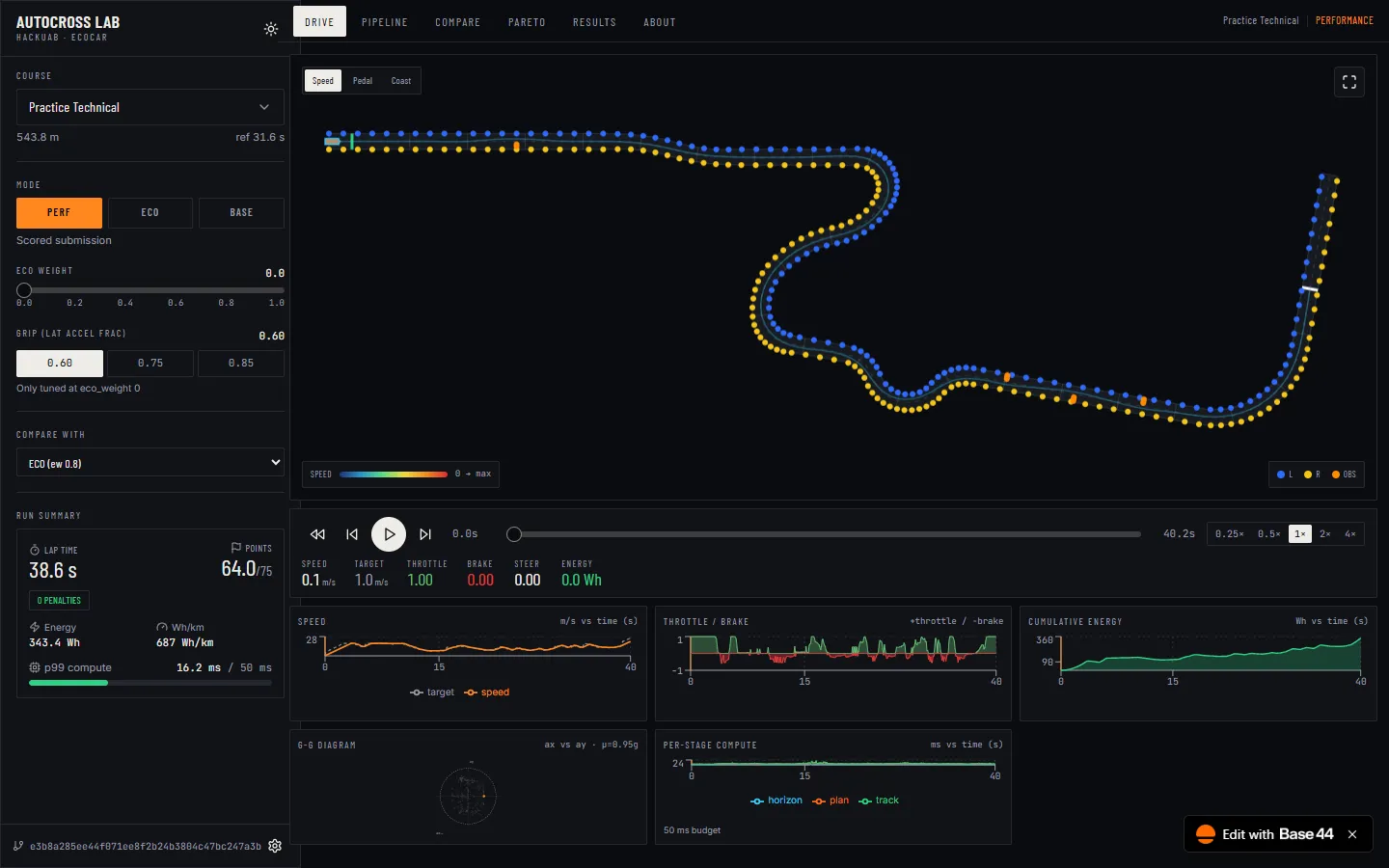
A real-time Python controller that drives a simulated AWD electric race car around unseen autocross courses with no map: 36.8 s against the organizers' 39.5 s baseline.
Illustration of the idea, not the scored controller's output
The problem
The University of Alabama EcoCAR Innovation Challenge, autonomous autocross: drive a simulated all-wheel-drive electric vehicle around a cone-marked course with no map. The car only sees the next 40 m.
Constraints
- Return steering, throttle and brake 20 times per second within a hard 50 ms budget, on 1 CPU core, no GPU, in a sandbox.
- Scored tracks were unreleased, so the controller had to generalize. Scored on two simulators (CARLA 3D physics and a vehicle-dynamics model), half each.
What we built: a four-stage pipeline running every 50 ms
- Safe corridor: turns the 40 m preview into a corridor shrunk for the car’s width, reshaped around obstacle cones (picks the wider gap, with hysteresis).
- Racing-line planner: a minimum-curvature racing line re-solved every step as a regularized least-squares problem in pure NumPy, warm-started for stability; a grip-based speed profile with forward/backward passes and a visibility guard for sharp corners just past the horizon.
- Physics-based prediction & plan verification: a vectorized dynamic bicycle model of the AWD car (tyre saturation, load transfer, 40/60 drive split, steering lag, drag) simulates the next 1.5 s, and slows the plan wherever predicted grip or rear-tyre slip would exceed limits.
- Tracking controller: curvature feedforward plus pure-pursuit feedback with latency compensation, and an AWD per-axle traction model (traction control/ABS-like) with online slip adaptation.
Safety layer: per-stage fallbacks, timing and a compute-budget guard; a blocked-road safety stop.
Beyond the core controller: an interactive web visualizer that replays every simulated lap, walks through the four stages and compares the modes, and a sensor-fusion prototype (lidar, radar, camera → cone detections), built separately from the scored controller.
Trade-offs
PERFORMANCE vs ECO modes: a built-in energy meter (energy balance within 5%) and a Pareto front of lap time vs energy. ECO uses about 30% less energy for about 10% more lap time, still with zero cones.
Results
| Organizers’ baseline | Our controller | |
|---|---|---|
| Lap time, hardest practice course | 39.5 s | 36.8 s |
| Cones hit, same course | 4 | 0 |
| Technical score, same course | 57.5 / 75 | 68.1 / 75 |
| Technical score, other public courses | 59.5–66.5 | 70.2–71.5 |
- 0 cone hits, 0 off-course, 0 missed gates, 0 controller errors across all public courses and randomly generated unseen tracks, in both modes (22 validation laps).
- About 10 ms per decision against a 50 ms budget. 129 automated tests.
My role
- Owned the racing-line planner and the physics-based prediction and verification model.
- Built ECO mode, the energy meter and Pareto analysis, and the blocked-road safety fix.
- Built the interactive visualizer.
- Coordinated the team: project plan, merges and integration testing, submission, pitch and demo video.
- (Viraj: tracking controller, integration, CARLA validation. Saisi: corridor/obstacle module, sensor-fusion prototype.)
How we worked
Module ownership per teammate with data contracts and self-test gates before merging; every change validated on randomly generated tracks to avoid overfitting; several Claude Code and Codex agents in parallel git worktrees, each owning one module, with human review before merge.