Cairn
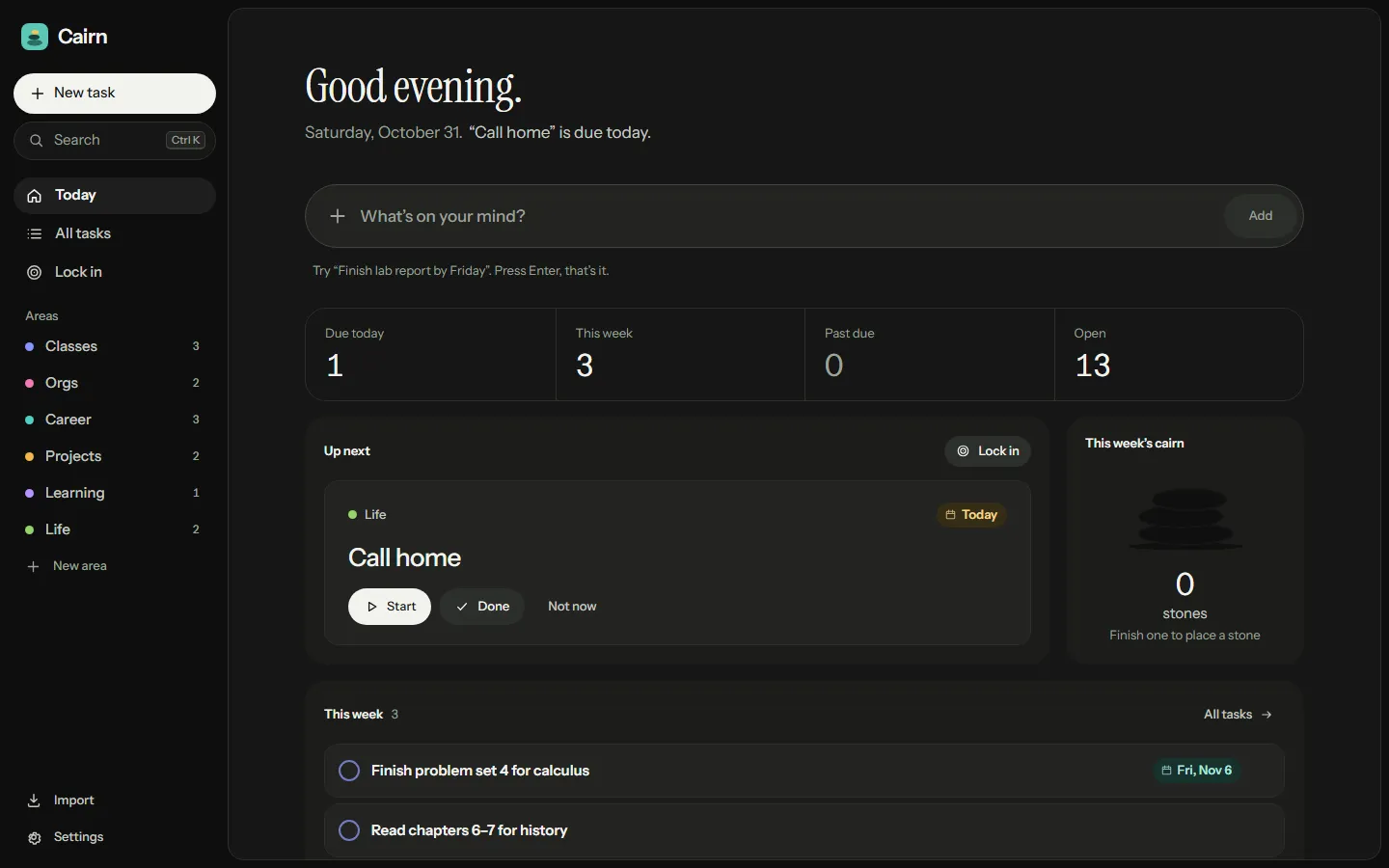
A calm, local-first task planner for brains that get overwhelmed by long lists. Type a task in plain words; it shows you one next step.
- 846unit & integration tests, plus 33 end-to-end
- ~12,100lines of TypeScript
- ≈$0.001AI cost per captured task
The problem
Most to-do apps assume you already plan well. For students, and anyone with ADHD, they turn into a guilt pile: one long column, red overdue badges, a dozen fields per task, and no answer to “what do I do right now?”
What I built
- An installable, offline-capable PWA in React 19, TypeScript, Zustand and Zod (~12,100 lines) on IndexedDB. Everything stays in the browser unless the user turns on sync or the assistant.
- A natural-language capture box: a tokenizing parser turns “Finish lab report by Friday !” into a task with an area, a due date and a priority (15+ date forms, DST-safe). Importers handle 5 formats (plain text, Markdown/Obsidian, JSON, Todoist CSV), each with a reviewable preview.
- A dependency-aware planner that combines urgency scoring with Kahn’s topological sort on a priority heap and checks every new link for cycles. It orders 500 tasks with dependencies in about 10 ms.
- Lock in, a focus mode that shows one task and its next small step and says why it comes first. Three views of everything: List, a mind Map and a Radar where nearer the middle means sooner.
- An optional Claude assistant that turns a sentence into a task with ordered steps, with Zod-validated structured outputs, prompt caching and prompt-injection safeguards. It falls back to local planning on any failure. Switching from Opus to Haiku cut estimated cost 40× (≈ $0.001 per task), and lazy-loading the SDK cut the main bundle 33% (968 → 645 KB).
Security and privacy
- Optional end-to-end-encrypted sync (implemented and tested, not yet enabled in production): PBKDF2-SHA-256 (600,000 iterations) and AES-GCM-256 with non-extractable WebCrypto keys, ciphertext bound to its owner and version, and rollback protection, on Supabase Postgres with Row Level Security.
- A Cloudflare Worker proxy for shared AI access, with an origin allowlist, constant-time invite-code checks, Workers KV rate limits and streamed body caps, covered by 48 tests.
- A strict Content Security Policy; the build refuses to ship a secret key. The assistant sends only the new task’s text plus open-task titles, areas, dates and priorities. Notes and steps never leave the device.
Process and results
- Led 4 redesign rounds driven by user feedback, ending in a token-based design system with accessible menus, drag and drop, phone swipe gestures, full keyboard support and 4.5:1 text contrast. Automated design-QA failures fell from 4 to 0.
- 846 Vitest unit and integration tests (including the proxy’s 48) and 33 Playwright end-to-end tests (desktop, phone, offline). Triaged and fixed 31 findings from 3 parallel code-review passes (security, UI, logic).
- Deployed as a link-only beta on Vercel with a shared assistant; CI on GitHub Actions type-checks, lints, tests and builds on every push.